Performance Statements
Useful Links
WordHippo - Best thesaurus site for statement writing
1206 Spacing Trick Website - Easier that using the old word doc trick
Word Counter - Useful for O/EPB Performance Statement reworking
Air Force Approved Acronym List - Official AFPC updated list
Old EPR Bullet examples - Although outdated this site has good examples of bullets to capture job or actions. It only helps with examples as mental maps since Performance Statements use a different approach but similar structure.
Old EPR Bullet examples v2 - This link has similar options as the one above with AFSC examples to look into.
Major Graded Areas (MGA) Chart
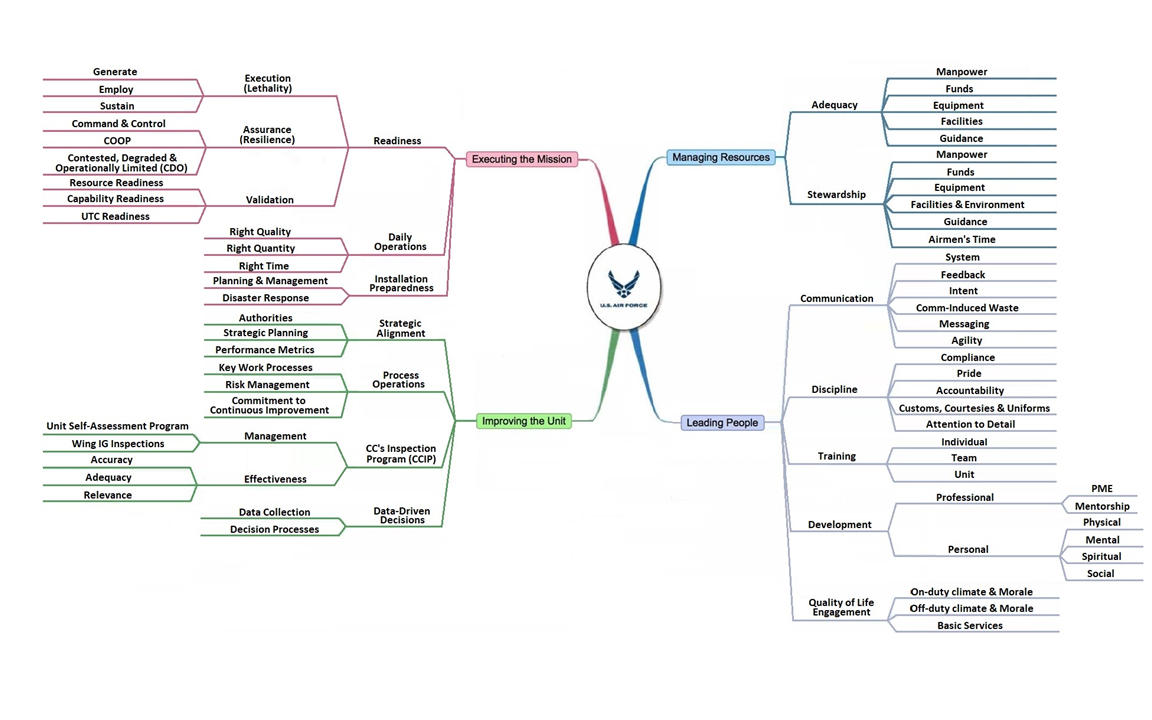
Performance Statement Methodology
*To make the best Performance Statement... "You need a hook, middle, and bomb ending"
Action - Impact - Result (AIR - Format)
The AIR format stands for Action-Impact-Result. It is the prevalent three-part structure used as the standard for writing and evaluating military performance statements and the previous "bullet" style.
Here is how the three components of the AIR model break down:
-
Action Element: This clearly describes the individual's specific contribution and defines their level of performance. It must explicitly state what the person did; without a clear action, the individual cannot realistically receive credit for the accomplishment.
-
Impact Element: This explains how the individual's performance influenced the next level and provides the scope of the effort. It serves as the vital "connector" between the initial action and the final result.
-
Result Element: This qualifies the final outcome of the effort and acts as the "measuring stick" to establish the overall value of the contribution. Strong results tie the individual's efforts directly to the "big picture," such as a strategic mission.
Applying AIR to Bullet Formatting
While the standard method is to write Performance Statements in the chronological Action-Impact-Result order, writers do not have to rigidly stick to this sequence.
Skilled writers will often engineer statements in alternative structures to position the strongest and most significant component at the very beginning of the line:
-
Standard Format: Action ➔ Impact ➔ Result
-
Reverse Format: Result ➔ Action ➔ Impact
-
Inverted Format: Impact ➔ Action ➔ Result
Summary: By placing the most powerful information first, the writer ensures that time-constrained evaluators will not miss the most critical aspect of the achievement.
Tactical - Operational - Strategic (TOS - Concept)
The TOS concept stands for Tactical-Operational-Strategic. It is a guiding framework used to evaluate how well the different components of a performance statement (the action, impact, and result) logically connect and flow together.
Based on Air Force Doctrine, the three levels of the TOS model are defined as follows:
-
Tactical Level: This involves specific, foundational tasks performed by individuals, primarily at the unit or sub-unit level.
-
Operational Level: At this stage, tactical skills are combined with leadership opportunities to impact a broader scope, such as an entire theater or joint operations area.
-
Strategic Level: This top level transitions into leading and directing exceptionally complex, multi-tiered organizations.
Applying TOS to Performance Writing
When writing or evaluating a performance statement, the TOS concept ensures there is a realistic and believable progression between what an individual did and the final outcome. A highly-rated bullet will show a clear, connected progression.
Example of Progression:
A tactical action (changing a tire in half the standard time) leads to an operational impact (the aircraft launches on time), which directly contributes to a strategic result (the aircraft successfully drops bombs on a target).
Note: Performance Statements can also be entirely tactical or entirely operational, as long as the components logically align with one another.
Avoiding the "Bridge Too Far"
The primary purpose of the TOS concept is to prevent faulty writing techniques where a writer makes an illogical jump from a minor tactical action straight to a massive strategic result.
Example of a Disconnected Bullet:
Claiming that replacing a few rivets on a single cargo door resulted in an entire $2 billion fleet becoming serviceable.
This is considered a "bridge too far" because the individual's specific action does not clearly or directly support the massive strategic claim. If the connection between the tactical action and the strategic result is missing or far-fetched, evaluators will often give the bullet zero credit.
Summary: Ultimately, the TOS model reminds writers that individuals should only receive credit for actions, impacts, and results that logically and explicitly connect to one another.
Writing Traps
Writing traps are common flaws, bad habits, and contextual blunders that writers frequently fall into. These traps obscure the actual value of an individual's accomplishments and result in ambiguous or weak performance statements.
To ensure your statements are properly credited and trustworthy, avoid the following Top 10 Writing Traps:
-
Making Promises: Attempting to take credit for an event or result that has not yet occurred, such as claiming expected college credits simply for studying for an exam.
-
Faulty Lead-In: Using an ambiguous or fluffy phrase at the beginning of a statement, such as "Hard Charger!", which fails to convey actual performance. If a lead-in is used, it should establish a concrete level of leadership that is supported by the rest of the statement, such as "Base mentor".
-
Led Effort: Stating that an individual "led an effort" culminating in a major award, but failing to describe what they actually did or how they led. This leaves the evaluator unable to attribute the success to the individual's specific actions.
-
Job Title: Using a role or "mini-job title" (e.g., "Top 3 president") at the start of a statement without providing specific actions or impacts to back it up, effectively giving a job title without describing the performance.
-
The Death Statement: Claiming a stellar, strategic-level result (like an "outstanding" inspection grade) but pairing it with vague, tactical actions (like "persistence"). This creates an illogical jump and leaves the result unconnected to the individual's specific efforts.
-
Lazy Writing: Using vague, unsubstantiated claims to describe a result, such as saying a process was made "more efficient" or "reduced costs" without citing measurable data or researching the actual impact.
-
Too Many Acronyms: Overloading a statement with abbreviations and jargon, which makes it an unreadable distraction. A good rule of thumb is to limit acronyms to one or two per line so the reader doesn't have to constantly reference the acronyms list website.
-
Bridge-Too-Far: Stretching a minor tactical action (like replacing rivets on a single cargo door) to claim a massive strategic impact (like making an entire $2 billion fleet serviceable). Evaluators view this as embellished and suspect.
-
Know Your Audience: Omitting critical context that an external reviewer wouldn't know. For instance, failing to explain that earning a specific medical license required a rigorous two-year program and board exams means the evaluator might severely undervalue the accomplishment.
-
Who's Your Audience: Forcing time-constrained evaluators to hunt for your best accomplishments by burying key achievements or diminishing them with poor formatting. For example, writing abbreviated jargon like "bach deg" at the end of a statement instead of proudly leading the sentence with "Awarded Bachelors!".